Welcome to our blog! We post our weekly inspirational emails and monthly newsletters here as a resource for caregivers. You can use the search window to search by blog “tag” or the archive index to search blog by theme (from our curriculum).
SEARCH OUR BLOG ARCHIVES:
Archive
- Advocacy
- Attitude
- Burnout Prevention
- Caregiver Support
- Cognitive Wellness
- Collaboration
- Common Humanity
- Courage
- Creative
- Creative Empowerment
- Dream Big
- Emotional Wellness
- Empowerment
- Environmental Wellness
- Growth Mindset
- Management
- Mental Health Awareness
- Mindfulness
- My Place in the World
- Newsletters
- Outlook
- Outside Interests
- Physical Wellness
- Programs
- Relationships
- Self-Care
- Self-Discovery
- Setting Intentions
- Social
- Spiritual Wellness
- Tenacity
- Vocational
- Wellness
- You Have Power to Grow
- Your Body is a Temple
“Caring for myself is not self-indulgence, it is self-preservation.” ~ Audre Lorde
What comes to mind when we talk about “holding space” for ourselves?
For me, it starts with MAKING space. It means recognizing that my capacity is finite, and it’s important to intentionally set aside some of it to care for my own needs. At this stage of my life, I’m focusing on the basics: healthy nutrition and hydration, regular movement, and making sleep a priority. These are not luxuries—they are the foundation that helps me continue showing up for the people and causes I care about.
I think of my time, energy, and attention as finite resources. There are only so many hours in a day and only so much of me to give. Yet so much of who I am is infinite. My ability to learn, grow, adapt, cope, love, and hold hope has no fixed limit. Holding space for myself means honoring both realities—respecting the finite resources I have today while nurturing the infinite possibilities within me. When I do that, I am not taking away from others; I am strengthening my ability to continue the journey with resilience, purpose, and hope.
"No matter your features
We're all the same tender loving creatures
Taking steps upon the earth
Don't need anyone to tell you what you're worth"
-"Power," MILCK
At Courage to Caregivers, we view EMPOWERMENT as vital to our roles as family caregivers. Empowerment, put simply, is the state of being able to take charge of our own lives. Through empowerment, we are able to embrace the courage we need to think creatively, ask for help when we need it, and take advantage of our strengths and skillsets as caregivers.
We find empowerment through reflecting on who we are as people and how we want to learn and develop. From there, we can recognize how capable we already are, and how we can keep growing. Empowerment doesn't mean we have to struggle alone. Instead, it's about recognizing and embracing our ability to make change in our own lives. As singer-songwriter MILCK says in her anthem "Power," you "don't need anyone to tell you what you're worth."
3 TOOLS FOR BECOMING EMPOWERED
Shift your mindset - Empowerment is all about taking control of your own life, and this includes your mindset. As we discussed in May when we covered growth mindset, we have the ability to shift our thinking away from "I can't" to "I can learn."
Reflect on your values and goals- In order to know what you need, it's vital to take a moment to reflect on what you care about and how that relates to what you would like to become. What strengths do you have? Where would you like to grow?
Find your community- Caregiving can feel incredibly isolating at times. That's why finding a caring community that can support and cheer you on can be instrumental in lifting you up and empowering you to be your best self.
Check out the complete June 2026 Newsletter focused on Empowerment here.
“One of the greatest regrets in life is being what others would want you to be, rather than being yourself.” — Shannon L. Alder
Establishing healthy boundaries is important, but caregiving is rarely that simple. When someone we love is struggling, our instinct is to help. We want to ease their suffering, prevent mistakes, and make things better. Yet, by helping, we might also be enabling—unintentionally getting in the way of someone else's growth, independence, or ability to solve problems. The challenge isn't choosing between caring and setting boundaries. It's learning how to do both in a way that protects our well-being while supporting our loved one’s growth and independence.
“You can’t use up creativity. The more you use, the more you have.” — Maya Angelou
Sometimes, we can make the best progress by returning to what worked in the past. I’ve been facing my own challenges of caregiver burden recently and working very intentionally on managing my stress to better regulate my parasympathetic nervous system which has been working on overdrive lately. I’ve been returning to many practices I’ve used in the past to find the ones that work best and “stick”. A trusted friend and former colleague reminded me about the practice of “tapping” or Emotional Freedom Techniques (EFT).
Tapping can strengthen our protective factors such as emotional awareness, coping skills, emotional self-regulation, and hope. Tapping has been found to reduce stress and regulate our nervous system, improve our self-compassion, reduce anxiety or racing thoughts, reduce burnout and ultimately lead to building our resiliency. It can also open the mind and body to new ways of looking at creativity.
When was the last time you tried something new? Were you scared? Were you excited? What pushed you to take that step forward? Taking that first step forward can be terrifying. We worry about what will happen if we mess up. We agonize over the impacts our actions can have on our loved ones. Sometimes it can feel safer staying to what we know rather than risking the chance of failing and having to face our guilt and shame.
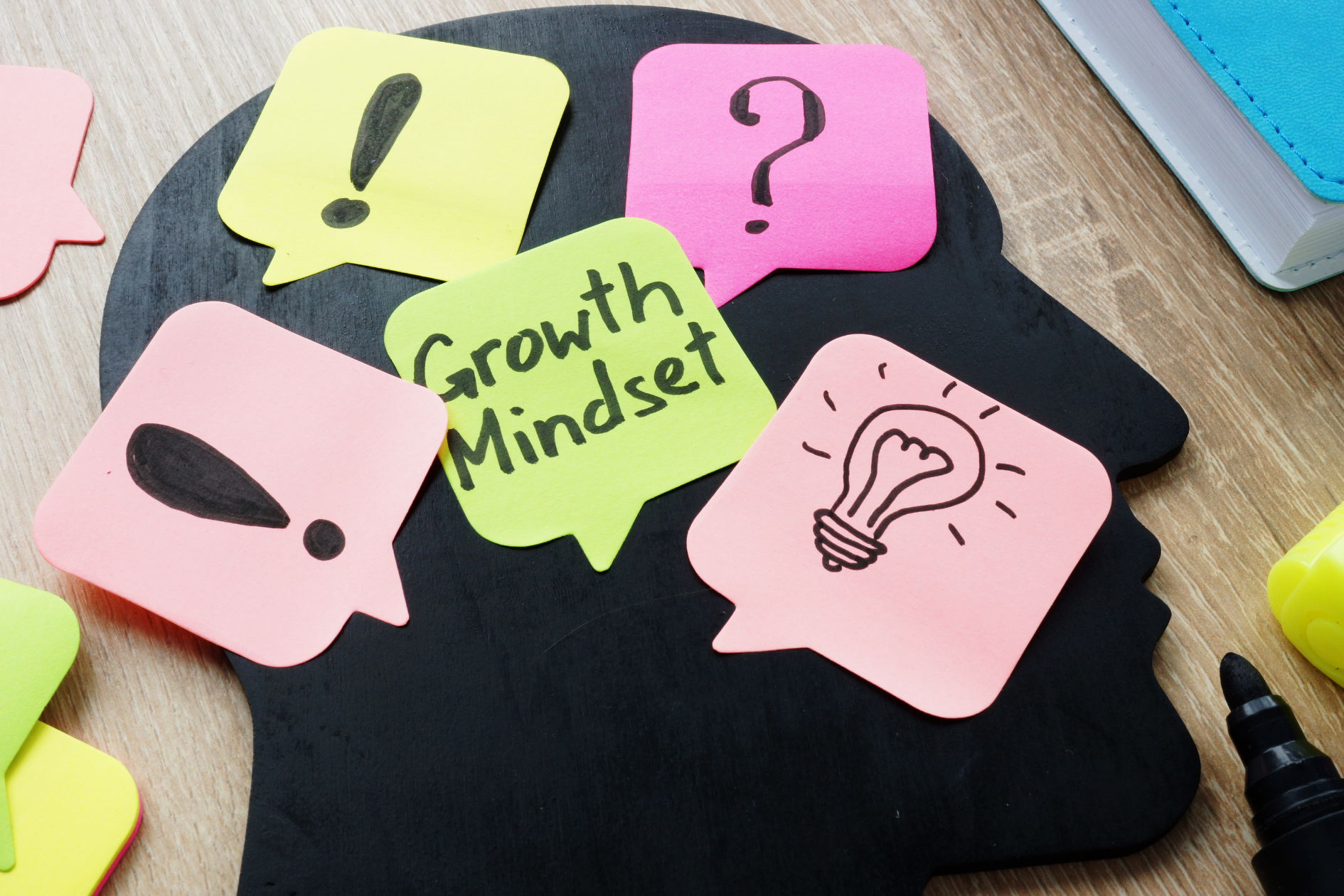
A GROWTH MINDSET reminds us that learning is not finite. There are always ways for us to grow from our mistakes and find new ways forward. Just because we messed up today does not mean that we will fail forever. We are worthy of the same love and compassion we give to others.
3 TOOLS TO FOSTER A GROWTH MINDSET:
Believe inYourself - You can't start learning if you don't believe in your capability to change and grow. How do you talk to yourself in your mind? Trade demeaning self-talk for self-compassionate words.
Making Mistakes Is Part of the Process - It's hard to learn if you are not willing to make the mistakes that teach you how you can grow. Mistakes can be lessons, and they do not have to define you.
Be a Life-Long Learner - What piques your curiosity? Even everyday things like wondering how you can change your morning routine can lead to self-growth. Take the time to find what you are passionate about, and learn!
Check out the complete May 2026 Newsletter focused on Growth Mindset here!
“It does not matter how slowly you go as long as you do not stop.” — Confucius
When was the last time you started something, then someone needed something from you, and you didn’t get to finish that first “something”? This happens to me ALL the time. Honestly, part of it is that my home office doesn’t have a door. The other part is that I’m very distractible. My brain goes a million miles a minute, and I’m juggling a lot of balls.
“Shame corrodes the very part of us that believes we are capable of change.” ~ Brené Brown
If there’s anything I know about guilt and shame, it’s that they thrive in the darkness. Digging deep into those dark recesses is hard to do. But when you’re ready, you can bring these thoughts out into the sunshine where shame can’t live.
“Polarized thinking traps us in trade-offs, while both/and thinking helps us find more creative and sustainable ways forward.” ~ Wendy Smith and Marianne Lewis, Both/And Thinking
Unpaid family caregiving rarely fits into simple either/or categories. But sometimes we can become stuck in polarized thinking — believing we must choose between caring for others or caring for ourselves, being hopeful or being realistic, feeling grateful or feeling overwhelmed — which can increase stress, guilt, and emotional exhaustion.
“Curiosity creates possibilities and possibilities create hope.” ~ Unknown
You know me to often write from my own lived experience in bringing a weekly topic to life, and that’s the case this week for the topic of staying curious. This is hard to share, but our 91-year-old mom has a new diagnosis of dementia. Looking back, it came on slowly, as these things often do, yet a recent infection aggravated it significantly. Adding this to my PhD in lived experience, I have a newfound appreciation for dementia caregivers.
"Common humanity focuses beyond our relationship with ourselves to our relationships with others and the world. It's about realizing how much we share as fellow humans. If we broaden our compassion for others, we can extend that compassion to include ourselves." - Jennifer Gerlach, LCSW
What do you believe you have in common with the person sitting closest to you? What about the people down the street? The people in the next city/town over? What about those on the other side of the globe? Today, it can feel so hard to find connection when it feels there is so much that divides us, from varying beliefs to differing values to conflicting understandings of the world.
Recognizing common humanity is not about smoothing over or ignoring these differences, but remembering that we all know what it feels like to be messy and unsure, to experience pain and loss. According to Dr. Kristin Neff, common humanity is a necessary part of self-compassion. We may not experience hardship the same way, but we all struggle. As Dr. Neff says, "Unlike self-pity, which says poor me, self-compassion says poor us." By recognizing the ways we can connect through our common humanity, we can build stronger and more meaningful relationships and be kinder to ourselves and others.
3 Tools to Help Appreciate Our Common Humanity
Remember that we are not alone. It can sometimes feel easier to see what divides us than what brings us together. However, common humanity is not the absence of difference. Common humanity simply means recognizing that, even with our differences, we are still human and have the capacity to connect with one another.
Practice self-compassion. As we emphasize here at Courage to Caregivers, we cannot be truly kind to others if we are not also taking care of ourselves. Remind yourself that you are doing the best that you can, and talk to yourself as you would a beloved friend.
Embrace connections. Focus on what connects us to other people rather than only what makes us different. By building connections based on our common humanity, we can support both ourselves and those around us.
Check out the complete April 2026 Newsletter focused on Common Humanity here!
“Alone we can do so little; together we can do so much.” ~ Helen Keller
Did you know loneliness is considered a major public health concern? Former U.S. Surgeon General Dr. Vivek Murthy has described an “epidemic of loneliness,” noting that even in a world where we are more digitally connected than ever, many of us still lack meaningful connection. Research suggests that the health risks of chronic loneliness can be comparable to smoking up to 15 cigarettes per day, highlighting the essential role that connection plays in our emotional and physical well-being. For unpaid family caregivers, strengthening connection is a protective factor that supports resilience and helps prevent burnout.
“Some things in life cannot be fixed. They can only be carried.” — Megan Devine
There are ALL kinds of grief and loss that caregivers face on a daily basis. I’m choosing to focus on the one that I battle with every day—ambiguous loss. Ambiguous loss is a form of grief that occurs when there is no clear closure or resolution, such as when a loved one is physically present but psychologically changed, or psychologically present but physically absent. It’s that feeling that the future you envisioned for yourself and your loved one, no matter the relationship, is different and may never unfold as planned.
“When you change the way you look at things, the things you look at change.” – Wayne Dyer
Caregiving is deeply human work. Across cultures, generations, and life experiences, people step into roles of supporting loved ones through illness, disability, mental health challenges, aging, and times of uncertainty. While every caregiving journey is unique, one truth connects us all: We were never meant to do this alone.
When life seems to be breaking apart around us, being told to "be mindful" can feel insensitive at best and downright insulting at worst. Why should we center on ourselves when there is so much we have to do as caregivers? But mindfulness, can be instrumental in encouraging self-compassion, which in turn can inspire greater empathy.
Mindfulness is the "moment-by-moment awareness of our thoughts, feelings, bodily sensations, and surrounding environment, through a gentle, nurturing lens" (Source). According to a recent study, mindfulness and self-compassion are positively linked with empathy. By bringing self-compassion into our lives, we can more readily extend empathy toward other people.
How will you embrace mindfulness and self-compassion in your daily life?
3 TOOLS FOR SELF-COMPASSIONATE MINDFULNESS
Self-compassion as a practice of good will - It's important to remember that self-compassion is about accepting our present moment and circumstances so we can open ourselves up to growth. While we may not be able to make the pain go away in the moment, we can prepare ourselves to take action.
It's okay for self-compassion to feel hard - It's normal to struggle to practice self-compassion and find yourself remembering old pains. When that happens, focus on your breath and bodily sensations. It's okay to learn self-compassion at your own pace. By doing so, you are already practicing self-compassion!
Try the self-compassion break - The self-compassion break is a mindfulness practice that can help in moments of stress. First, acknowledge that this a stressful moment. Next, remember that you are not alone in struggling. Finally, recognize a kind phrase toward yourself such as "may I be strong" or "may I be patient."
(Adapted from "Self-Compassion Practices" by the Self-Compassion Institute)
Check out the complete March 2026 Newsletter focused on Mindfulness here.
“Laughter is the sun that drives winter from the human face.” ~ Victor Hugo
Happiness can feel elusive—or even out of reach—when life and caregiving feel heavy. So many of us have heard the saying, “You’re only as happy as your least happy child,” but I’ve never subscribed to that belief. If we hinge our emotional well-being entirely on someone else’s struggle, we lose our ability to care for ourselves, and we drain the very resilience we need to keep showing up.
“The present moment is the only time over which we have dominion.” — Thích Nhất Hạnh
In my peer support work, I support a lot of caregivers who either focus on the future or ruminate about the past. “What-if’s” fill our heads, and as caregivers, we’re SO good at living in our heads. We’re prone to overthinking, worrying, and remaining in perpetual motion. Even in the middle of the night! (If that’s your most challenging time of day, like it is for me, try our breathing practices. Box breath or 4-7-8 are my favorites.)
“Between stimulus and response, there is a space. In that space is our power to choose our response.” ~ Viktor Frankl
Do your loved ones have a tough time regulating their emotions? Or is that just mine? I used to love to blame them when these blowouts happened. Then, I realized that I needed to focus on what’s in my control. My emotional response to others is something that I can definitely control.
FEBRUARY THEME: Self-Discovery
“Finding oneself is a journey, not a destination.” — Unknown
In January, we discussed the power of setting intentions for who we want to be. Now at the end of February, we are well into our personal journeys of self-discovery. Some of us may be finding our paths as straightforward as we had hoped while others of us may be feeling challenged by the unexpected directions our roads are taking us. Wherever you may be on your journey, now is a great moment to pause and reflect.
As the quote states above, self-discovery is about the journey, not the destination. How have you grown in the last two months? Where do you hope to improve? Who has supported you? By taking a break to reflect, we can recognize our own inner strengths and treat ourselves with the self-compassion we need.
TOOLS FOR SELF-DISCOVERY
Be Compassionate Toward Yourself. While this is often easier said than done, remember that there are MANY ways to be compassionate toward yourself. Check out this toolkit for some suggestions!
Look for Joy in Your Life. Acknowledging joy in your life does not mean ignoring your pain or sadness. Rather, finding joy can mean recognizing the small and big things that boost your soul and encourage you to keep going even during challenging times.
Identify Your Strengths. We all have strengths that motivate us and help us through difficult dilemmas, but identifying them can be tricky. Sometimes just starting with the activities you enjoy or what others have complimented you on can be a good start.
Remember, you got this! Best wishes as you journey on! 💙
Check out the complete February 2026 Newsletter focused on Self-Discovery here.
“With self-compassion, we give ourselves the same kindness and care we’d give to a good friend.”
~ Dr. Kristin Neff
As caregivers, if there’s anything we’re really good at, it’s providing care to others. Then, why is it so hard to care for ourselves, too? We’re often hard on ourselves—beating ourselves up with self-doubt, self-blame, negative self-talk, and could-have–should-have thoughts.
“When you know your strengths, you know where you can be strong on purpose.”
— Marcus Buckingham
Caregiving is hard, but none of us comes to this journey empty-handed. We bring skills, values, and inner resources that help us navigate our challenges and achieve our goals. Identifying those strengths is part of self-discovery. When we slow down enough to understand who we are beneath our responsibilities, we gain clarity about what sustains us and what drains us. This knowledge helps us shift from surviving each day to caring with intention.
“Sometimes the smallest things take up the most room in your heart.”
— A.A. Milne
Oh how I wish my caregiving was full of rainbows, unicorns, and sunshine all the time. Just as in life, caregiving comes with its good days and bad days, its joys and its sorrows. There have been more days than I can count where I’d love to push the “easy” button.
JANUARY THEME: Setting Intentions
“By recording your dreams and goals on paper, you set in motion the process of becoming the person you most want to be. Put your future in good hands — your own.” ~ Mark Victor Hansen
The beginning of the year often comes with exhilaration as we make bold plans to establish new habits, renew promises to ourselves, and look for areas for growth. But even as the possibilities excite us, fear may shadow us as we worry about what challenges this new year may hold and whether or not we are up to the task to meet them. As caregivers, we know all too well how quickly change occurs.
This is why we start with setting intentions. The simple act of establishing clearly what we will do this year can help guide us to our values and the actions we can take to realize them. We can manage our expectations while staying open-minded to the opportunities that come our way. By using "I will" statements rather than "I want" or "I won't" phrases, we can shape our intentions with the strengths we already have and desire to build, and, as a result, guide our decision-making and behavior to align with our goals.
3 TOOLS FOR SETTING INTENTIONS
Find Your Inner Peace. Start with the person you are in this moment. Remind yourself of who you are, what you value, and how you can leverage your strengths.
Remember, You Have the Power to Design Your Own Life. You get to decide what your life becomes! Reflect on your values and strengths to see what areas you would like to focus on this year.
Practice Self-Compassion. Obstacles are bound to happen! Be gentle with yourself and remember that you are doing everything you can in this moment with the knowledge and resources you have. Progress is the goal, not perfection. You got this!
Check out the complete January 2026 Newsletter focused on Setting Intentions here.
“Flexibility is the key to stability.” — John Wooden
Caregiving often requires stability in the middle of uncertainty. Many of us believe that stability means holding firm—sticking to routines, pushing through exhaustion, and keeping everything from falling apart. But stability also requires flexibility, as John Wooden reminds us in the quote above, and flexibility stems from open-mindedness.
For caregivers, open-mindedness isn’t about giving up standards or caring less. It’s about adapting in ways that help us stay grounded over the long haul. When we allow ourselves to be flexible, we reduce the pressure to have everything figured out and make room for a stability that is realistic, humane, and sustainable.
“If I pretend to myself that I’m different from the way I truly am, I’m going to make choices that won’t make me happy.” — Gretchen Rubin
I’ve written about Gretchen Rubin’s book, The Four Tendencies, before. After reading it a few years ago, I just knew we had to add “managing expectations” as one of the topics in our curriculum! Besides healthy boundaries and navigating guilt and shame, I’d say managing expectations is one of the things we talk about most with caregivers.
“We don’t learn from experience; we learn from reflecting on experience.” — John Dewey
I don’t know about you, but I have a complicated relationship with New Year’s resolutions. I don’t subscribe to the “New Year—New YOU” mantra. Here at Courage to Caregivers, as we begin our 8th year of providing programs to support unpaid family caregivers and working to prevent caregiver burnout, I am reflecting on all of the practices I have created for myself. One of those is setting intentions, which is our theme for January. Setting intentions for yourself is all about focusing on WHO you want to BE instead of WHAT you want to DO. After all, we’re human beings, not human doers. Being is at the heart of self-care.
“It's your outlook on life that counts. If you take yourself lightly and don't take yourself too seriously, pretty soon you can find the humor in our everyday lives. And sometimes it can be a lifesaver.” - Betty White
How would you describe your outlook on life? Hopeful? Cautious? Fluid? Static? Taking the time to understand our outlooks can help us better understand how we react to the various people, situations, and challenges we face in our lives. Our outlooks can have powerful impacts on the decisions we make. Do we take advantage of an opportunity that comes our way or do we let it pass? How much do we believe in our own inner strengths and our abilities to find support?
Cambridge Dictionary defines OUTLOOK as "a person's way of understanding and thinking about something." When we have a hopeful outlook, we are able to feel motivated to learn and improve. When we are open-minded, we feel capable of turning possibilities into realities. While simply changing our outlooks will not erase all of the barriers we face in life, it can help guide us to certain actions and energize us to persevere and obtain the support we need.
3 TOOLS TO MAINTAIN A HEALTHY OUTLOOK
Have a hope-centered mindset.Hope reminds us of our inner strengths and ability to enact change. As the world shifts around us, our hope can also wax and wane, but remember that hope is not a finite resource. We can always find hope in ourselves and in our surrounding environments and communities.
Cultivate inner peace. Our days can be filled with chaos and it is easy to feel as if we have no control over our own lives. However, by taking the time, even if it's only five minutes, to find our inner calm, we can feel more prepared to tackle the challenges we face.
Embrace possibility thinking. By engaging with possibilities, we can allow ourselves to recognize what we want to happen in our lives. Once we recognize what we want, we can then understand the steps we have to take to make those wishes come true.
Check out the complete December 2025 Newsletter focused on Outlook here.
“The wound is the place where the light enters you.” — Rumi
For unpaid family caregivers, the winter solstice often feels less like a calendar event and more like a mirror. It is the longest night of the year—a season that echoes the exhaustion, isolation, and emotional weight that caregiving can bring. Rather than asking us to push through or “stay positive,” the solstice offers something caregivers rarely receive: permission to pause (especially at this hectic time of year). It invites us to acknowledge the darkness honestly, without judgment, and to honor all we have done to simply keep showing up.
“In the middle of difficulty lies opportunity.” — Albert Einstein
Like you, I am no stranger to challenges. I have faced many difficulties throughout my life. I have learned that I have the choice to look at these times in my life as challenges or opportunities. Just like learning from my mistakes, I try to learn what I can during times of personal or professional distress.
“Peace does not mean to be in a place where there is no noise, trouble, or hard work. It means to be in the midst of those things and still be calm in your heart.” — Unknown
In an increasingly uncertain and turbulent world, cultivating inner calm has become essential for staying grounded and connected to what truly matters. Experts across psychology, spirituality, and personal growth emphasize that inner calm begins with turning inward—allowing ourselves to gently acknowledge our fears, vulnerabilities, and emotional divides. As Tara Brach explains, when we courageously make space for our own difficult feelings with kindness and presence, we strengthen our ability to extend compassion to others. This inner tenderness becomes the foundation for greater peace, intention, and connection, helping us navigate anxiety, conflict, and the weight of the world with clarity and resilience.
“Once you choose hope, anything is possible.” — Christopher Reeve
Overall, I am a very hope-filled person. Yet, there have been times when I haven’t always been able to find hope. I wouldn’t say I was hopeless, but I have supported loved ones who were. When providing mental and emotional support for my brother who lived with anxiety, depression, and obsessive-compulsive disorder, as well as suicidal ideation, I believed he had given up on hope. As he gradually lost hope, I felt hope slipping away for me, too. So much that when our family created our walk team for the local suicide prevention organizations we support, we named ourselves the “Hope Seekers.”
I found my way back to hope. It was a conscious choice—a mindset—and something I have worked on for many years. I have since studied the science behind hope, and what I’ve discovered is nothing short of inspiring.
Hope isn’t just a feel-good emotion, it’s a powerful, measurable driver of well-being. Two large research efforts, including a 14-year study of 25,000 adults, found that people with high levels of hope experience better health, stronger relationships, greater resilience, and improved economic, educational, and employment outcomes. Unlike optimism, which is simply believing things will get better, hope reflects determination, agency, and the ability to take action. Hopeful individuals are less affected by negative life events, adapt more quickly, and feel a greater sense of meaning in life. Researchers emphasize that hope is a skill that can be developed at any age and may be one of the strongest predictors of long-term fulfillment, longevity, and overall quality of life.